
Denim Is Hard to Buy Online. Ksubi Made It Easier.
6 min read
Ksubi's US store · randomized 50/50 holdout against Ksubi's own size chart · all three significant at p < 0.001. Fit help means Magic Fit or Ksubi's size chart; buyers, new customers and revenue count orders placed after using fit help, not every order. Ksubi's Australian store moved the same way on buyers and revenue.
- Brand
- Ksubi
- Category
- Premium denim (Australia & US)
- Platform
- Shopify
- Challenge
- Denim fit changes from one cut to the next, and a size chart only helps the shoppers who stop to measure themselves
- Timeline
- Holdout: 17 Sep – 18 Oct 2026
Denim is one of the most difficult categories to fit online: half-sizes are common; waist, rise and leg change from one cut to the next; black denim shrinks more aggressively than blue, making jeans in the same cut fit differently.
Ksubi already had a good size chart. But every size chart demands the shopper find a tape measure, which not everyone owns.
To find out if Magic Fit could help shoppers find their best size more quickly and easily, we ran a separate A/B holdout test on each of Ksubi’s stores (AU and USA).
Every shopper was randomly placed in one of two groups: half kept Ksubi’s size chart; the other half had the size chart and Magic Fit. Because the split is random, Magic Fit is the only difference between the groups, so any gap between them is what Magic Fit did.
We read each store on its own, and the figures here are from the US store (unless stated).
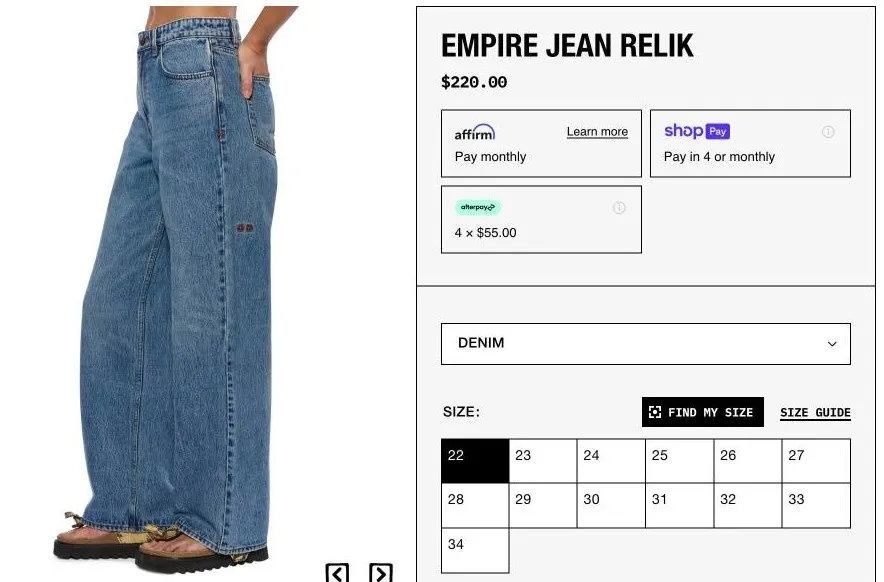
Shoppers in the Magic Fit group saw Find My Size next to Ksubi’s own size guide. Everyone else saw the size guide alone.
Magic Fit Reached a Different Shopper
Brands often worry that Magic Fit will just pull shoppers away from their size chart. At Ksubi, it didn’t.
Size chart use dipped only slightly, from 3.51% of shoppers to 3.24%. Meanwhile, the share using any fit help rose from 3.52% to 4.97%, a 41% increase.
These are shoppers who would otherwise have guessed their size. Magic Fit asks for their height and weight instead of a tape measure, and that’s enough to bring them in.
Around half of Magic Fit’s users wouldn’t have used any fit help without it.
Randomized 50/50 holdout, 17 Sep – 18 Oct 2026. Share of shoppers who reached a product page.
| Label | Series | Value |
|---|---|---|
| Used the size chart | With Magic Fit | 3.24% |
| Used the size chart | Size chart only | 3.51% |
| Used any fit help | With Magic Fit | 4.97% |
| Used any fit help | Size chart only | 3.52% |
What They Did Next
Getting fit help wasn’t where it ended. In the Magic Fit group, 53% more shoppers went on to buy after using fit help than in the size-chart group, and 64% more revenue came through fit help.
First-time customers moved with them: 50% more new customers ordered after using fit help, while new-customer orders store-wide held about level. Ksubi’s Australian store moved the same way, with about 45% more buyers using fit help.
Randomized 50/50 holdout, 17 Sep – 18 Oct 2026.
| Label | Value |
|---|---|
| Looked for fit help | +41% |
| Used fit help, then bought | +53% |
| New customers who used fit help | +50% |
| Revenue through fit help | +64% |
Store-wide, conversion and revenue per shopper in the two groups were within 2% of each other, so many of these shoppers would have bought anyway. The difference is how they bought: knowing their size, rather than guessing it.
Native to the US Shopper
As an Aussie label selling into the USA, getting the units right for every shopper regardless of geography is worth more than it sounds.
At Ksubi’s US store, showing shoppers feet, pounds and US bra sizes instead of centimetres and kilograms lifted Magic Fit results with a size by 21%.
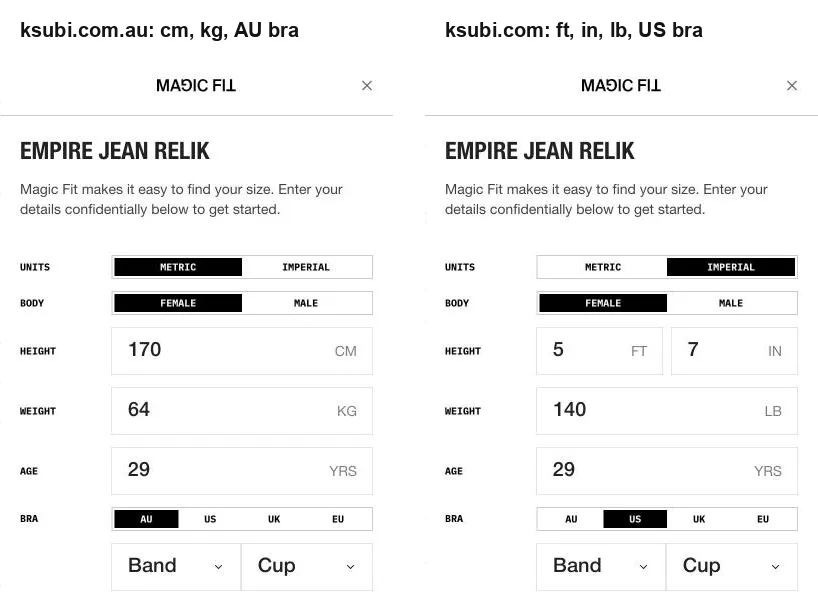
Results with no size found dropped from one in five to less than one in twenty. Most of the no-size results left are shoppers whose measurements sit beyond Ksubi’s size run.
Showing shoppers their own units in every field lifted results with a size by 21%.
Magic Fit US results by the units shown first: centimetres and kilograms 17 Sep – 8 Oct, inches and pounds 8 – 18 Oct 2026.
| Label | Value |
|---|---|
| Centimetres and kilograms first | 20.9% |
| Inches and pounds first | 4.5% |
The Point
Magic Fit doesn’t replace your size chart. Instead, it reaches a different shopper: the one who’d never open a chart in the first place and would simply guess.
At Ksubi, around half of Magic Fit’s users were those shoppers, and 53% more shoppers bought online after using fit help.
We’ll run the same holdout on your store during your trial, so you see your own numbers, whichever way they go.
Want a number measured on your own customers? Get in touch — we’ll run the holdout.
Methodology: Results come from a randomized 50/50 session-level holdout on Ksubi’s US and Australian Shopify stores, 17 September – 18 October 2026, read separately, with the control group keeping Ksubi’s native size chart and all p-values two-sided. The no-size rate is observational, comparing Magic Fit’s US results with metric and with imperial units shown first.
About the brand: Ksubi has been “the OG since ‘99”, from the beaches of Sydney to New York’s Greene St. It’s denim first: custom washes, the signature t-box and pocket flag, and a label built, in its own words, to “provoke and disrupt”. It sells online through its Australian and US stores, and in its own stores from Sydney and Melbourne to New York, Los Angeles, Chicago and Miami.